

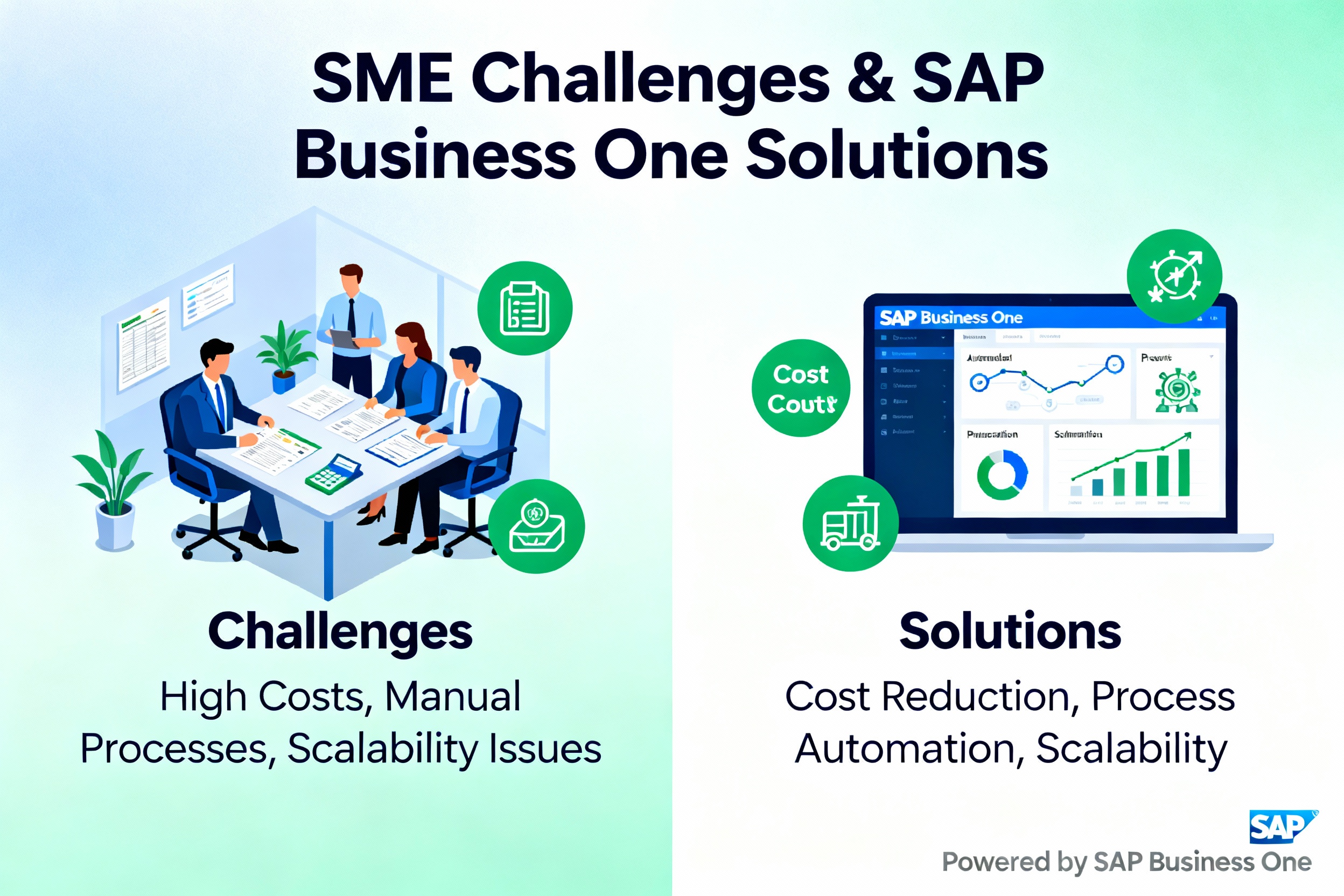
Introduction to SME Operational Challenges
Running a small or medium-sized enterprise (SME) isn’t a walk in the park. Between tight budgets, rising competition, and rapidly changing technologies, SMEs are under more pressure than ever. The Top 10 Challenges SMEs Face & How SAP Business One Solves Them is a topic many business owners search for because they know that modern tools can help—but understanding exactly how is the real challenge.
SMEs often juggle multiple tasks with limited resources. They may rely heavily on spreadsheets, disconnected software, or manual processes that slow them down. As a result, productivity drops, costs rise, and opportunities slip away. Thankfully, SAP Business One, a globally trusted ERP system, offers a complete solution tailored to SME needs.
Challenge 1 – Inefficient Business Processes
Impact of Manual Workflows
Manual processes create delays, bottlenecks, and higher chances of human error. SMEs commonly waste hours on repetitive tasks like data entry or approvals.
SAP Business One Automation Benefits
SAP Business One automates routine workflows, enabling:
- Faster approvals
- Streamlined data entry
- Error-free reporting
- Real-time updates across departments
This allows teams to shift focus from admin to growth-driving activities.
Challenge 2 – Limited Financial Visibility
Cash Flow Constraints
Many SMEs lack real-time insight into their financial health, leading to budgeting issues and unforeseen financial risks.
SAP B1 Real-Time Financial Insights
SAP Business One provides:
- Up-to-date balance sheets
- Automated journal entries
- Cash flow dashboards
- Built-in financial reports
This enables better decision-making and smarter financial planning.
Challenge 3 – Poor Inventory Management
Overstocking & Stockouts
Inventory issues can damage customer trust and drain cash flow. Many SMEs mismanage stock because they rely on guesswork instead of data.
SAP B1 Inventory Optimization Tools
Features include:
- Real-time stock tracking
- Automated reorder points
- Batch and serial number tracking
- Accurate forecasting
This ensures the right products are available at the right time.
Challenge 4 – Lack of Integrated Systems
Problems with Data Fragmentation
Using multiple disconnected apps creates duplication, inconsistencies, and confusion.
SAP B1 Unified Platform Advantage
SAP Business One unifies sales, finance, inventory, purchasing, and CRM in one platform—giving SMEs a single source of truth.
Challenge 5 – Weak Customer Relationship Management
Lost Sales Opportunities
Many SMEs fail to track leads and customer interactions efficiently.
SAP B1 CRM Capabilities
SAP B1 improves customer relationships through:
- Lead tracking
- Sales pipeline management
- Customer history
- Email and communication logs
This helps businesses close more deals and offer superior service.
Challenge 6 – Difficulty Scaling Operations
Growing Pains for SMEs
Growth often leads to chaos if processes aren’t scalable.
SAP B1 Scalability Features
SAP Business One grows with the business, offering:
- Add-on integrations
- Modular features
- Cloud deployment options
- Global compliance tools
Challenge 7 – Compliance & Reporting Struggles
Regulatory Burdens
SMEs must comply with taxes, audits, and industry regulations.
SAP B1 Automated Compliance Tools
- Audit trails
- Tax calculations
- Regulatory reporting
- Document management
These capabilities reduce risk and error.
Challenge 8 – Limited Decision-Making Insights
Data Interpretation Issues
Without proper analytics, SMEs make decisions based on gut feeling rather than facts.
SAP B1 Built-In Analytics
SAP B1 provides dashboards and KPIs that support:
- Trend analysis
- Sales forecasting
- Performance tracking
Challenge 9 – Workforce Productivity Challenges
Communication & Collaboration Gaps
Disconnected systems create delays and miscommunication.
SAP B1 Productivity Enhancements
Features like alerts, approvals, and shared data improve team efficiency.
Challenge 10 – Rising Operational Costs
Inefficient Cost Structures
Manual tasks, poor planning, and outdated tools drive costs up.
SAP B1 Cost-Saving Features
The system helps SMEs:
- Reduce labor hours
- Avoid inventory mistakes
- Improve financial planning
- Eliminate redundant software
FAQs – SAP Business One for SMEs
1. Is SAP Business One suitable for small businesses?
Yes, it is designed specifically for SMEs with limited budgets but complex operational needs.
2. How long does SAP Business One take to implement?
Most implementations take 4–12 weeks depending on customization.
3. Is SAP B1 available in the cloud?
Yes, SAP B1 is available on cloud and on-premise.
4. Can SAP Business One reduce operational costs?
Absolutely. It automates workflows, reduces errors, and consolidates software tools.
5. Does SAP B1 include CRM?
Yes, it includes robust CRM tools for sales and service teams.
Conclusion
Understanding the Top 10 Challenges SMEs Face & How SAP Business One Solves Them helps business owners find the right digital tools to stay competitive. SAP Business One improves efficiency, strengthens financial visibility, and prepares SMEs for long-term growth.