

Introduction: The Modern Customer Experience Revolution
In today’s digital economy, customer experience (CX) has become the ultimate competitive advantage. Businesses are no longer measured solely by the quality of their products or services but by how effectively they understand, engage, and retain customers.
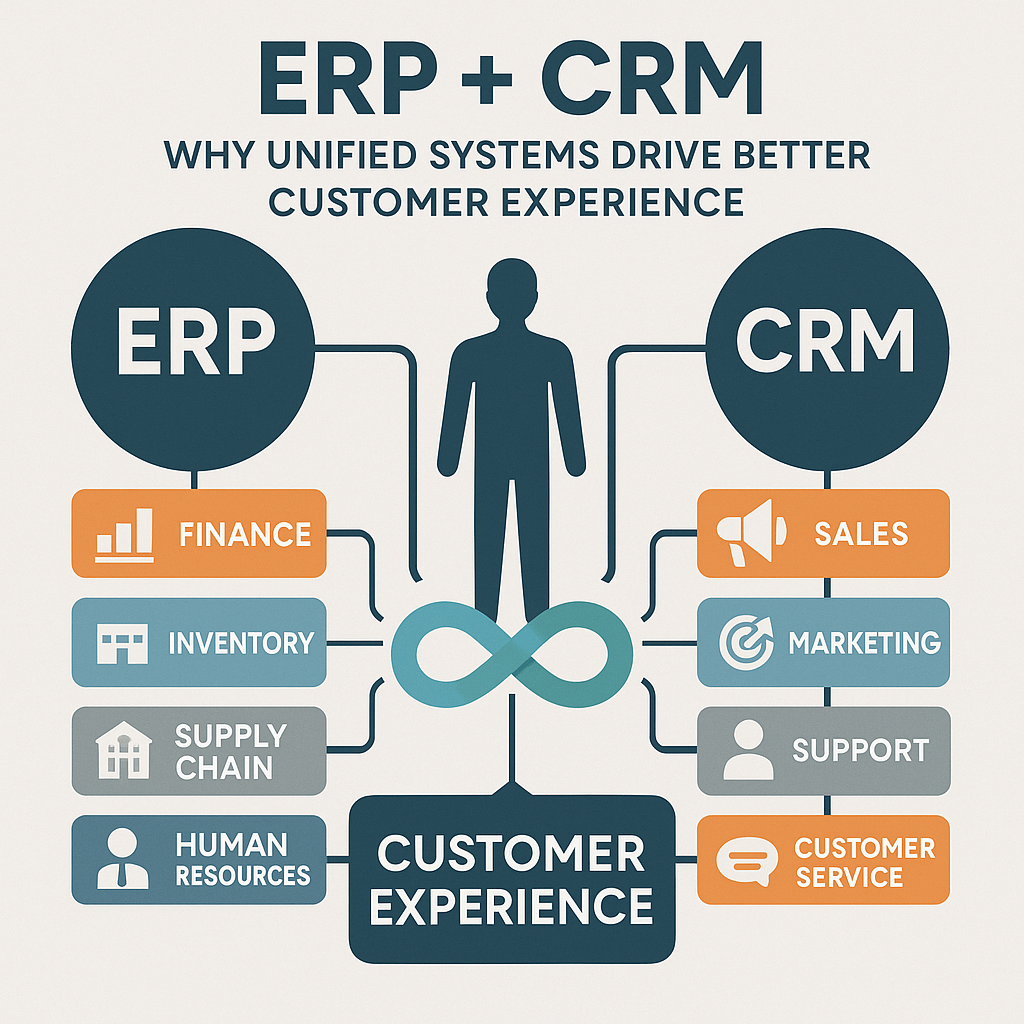
To meet rising customer expectations, companies need more than standalone tools—they require unified systems that connect operational and customer-facing data. This is where ERP (Enterprise Resource Planning) and CRM (Customer Relationship Management) integration transforms business efficiency and customer satisfaction.
A unified ERP + CRM system bridges the gap between operations and customer engagement, creating a seamless flow of information that empowers every department—from sales and marketing to finance and logistics—to deliver personalized, real-time customer experiences.
Understanding ERP and CRM Systems
What is ERP (Enterprise Resource Planning)?
ERP systems streamline and automate business processes such as accounting, inventory, production, and supply chain management. By centralizing core functions, ERP platforms help organizations reduce costs, enhance efficiency, and improve decision-making.
What is CRM (Customer Relationship Management)?
CRM software focuses on managing customer data, sales pipelines, marketing campaigns, and support interactions. It’s the front-end tool that helps businesses attract, nurture, and retain customers.
The Traditional Divide Between ERP and CRM
Historically, ERP and CRM operated in silos—ERP managed internal operations, while CRM handled external relationships. This separation often led to data inconsistencies, fragmented insights, and missed opportunities to create cohesive customer journeys.
Why Businesses Need Unified ERP + CRM Systems
Breaking Down Data Silos
Unified ERP + CRM systems eliminate data fragmentation. Customer information, order history, payments, and inventory data all flow seamlessly, ensuring that every team accesses the same real-time insights.
Real-Time Customer Insights Across Departments
When sales teams know inventory levels and operations teams understand customer forecasts, decision-making becomes proactive. This alignment enables personalized experiences and timely responses.
Streamlined Operations and Efficiency
Automation between CRM and ERP modules minimizes manual work, reduces duplication, and speeds up customer service delivery—from order placement to after-sales support.
How ERP + CRM Integration Enhances Customer Experience
360-Degree Customer View for Personalized Interactions
Integration allows businesses to view each customer’s journey holistically—covering their purchase history, preferences, and feedback. This enables data-driven personalization, improving engagement and loyalty.
Improved Response Time and Service Delivery
With connected data, customer inquiries can be resolved faster since agents have immediate access to product availability, shipping updates, and billing records.
Smarter Decision-Making Through Predictive Analytics
Unified systems harness analytics and AI to forecast trends, identify upselling opportunities, and predict customer churn—empowering businesses to take action before problems arise.
Key Benefits of Unified ERP and CRM Platforms
- Increased Productivity and Automation: Repetitive tasks like invoicing and reporting are automated.
- Better Sales Forecasting: Real-time data ensures accurate sales predictions.
- Enhanced Collaboration: Cross-functional teams share the same customer intelligence.
- Cost Savings: Reduced software redundancy and maintenance costs.
- Customer Retention: Consistent and personalized experiences boost loyalty.
Real-World Examples of ERP + CRM Success
Manufacturing Sector
Manufacturers use integrated ERP + CRM solutions to align production with customer demand, reducing lead times and improving order accuracy.
Retail and E-Commerce
Unified platforms help retailers track inventory, manage promotions, and deliver seamless omnichannel experiences.
Professional Services
Consulting firms use integrated systems for project tracking, client management, and automated billing—ensuring better client satisfaction.
Challenges and Considerations in Implementing Unified Systems
- Integration Complexity: Legacy systems may require careful data mapping.
- Employee Training: Teams need to adapt to new workflows and automation.
- Choosing the Right Platform: Evaluate scalability, customization, and vendor support.
Top ERP + CRM Solutions in 2025
- Microsoft Dynamics 365: A leader in unified business applications.
- Salesforce + SAP: Ideal for large enterprises needing advanced analytics.
- Oracle Fusion Cloud: Offers AI-powered automation and scalability.
Future Trends in ERP and CRM Integration
- AI-Driven CX: Predictive and generative AI tools personalize engagement.
- Cloud-Native Solutions: Scalable, secure, and low-code-friendly.
- Hyper-Personalization: Leveraging unified data for tailored interactions.
FAQs on ERP + CRM Unified Systems
1. What’s the main benefit of integrating ERP and CRM?
It centralizes data, creating a 360° customer view and improving business efficiency.
2. Can small businesses use ERP + CRM systems?
Yes, cloud-based solutions make integration affordable for SMBs.
3. How does integration improve customer service?
Agents gain real-time access to all relevant customer and order data, resolving issues faster.
4. Are there risks involved?
Integration requires planning to avoid data migration errors and user adoption challenges.
5. Which industries benefit most?
Manufacturing, retail, e-commerce, and professional services gain the most value.
6. What’s the future of ERP + CRM?
AI, automation, and predictive analytics will make systems more intelligent and customer-focused.
Conclusion: Building a Customer-First Digital Ecosystem
Unified ERP + CRM systems are no longer optional—they are the backbone of modern business strategy. By connecting data, processes, and people, these systems empower organizations to deliver exceptional, consistent, and personalized experiences.
As businesses move toward digital maturity, those adopting integrated platforms will stay ahead, turning customer insights into sustainable growth.