

Introduction: The Modern Supply Chain Challenge
The global supply chain has evolved into a complex web of suppliers, distributors, logistics providers, and customers spread across continents. With increasing globalization, political uncertainties, and digital transformation, businesses are under pressure to maintain visibility and resilience across every aspect of their supply chains.
Even minor disruptions—such as delayed shipments, material shortages, or cyber threats—can cause significant operational challenges. That’s why supply chain visibility (knowing where everything is, in real-time) and resilience (the ability to recover quickly) have become top priorities for enterprises worldwide.
This is where SAP Business One comes into play.
Why Supply Chain Visibility and Resilience Matter More Than Ever
Visibility provides clarity, while resilience ensures continuity. In today’s unpredictable business landscape, companies with transparent and agile supply chains can:
- Respond faster to changes in demand.
- Minimize financial losses from disruptions.
- Build stronger customer trust.
- Improve decision-making through accurate data.
A resilient supply chain doesn’t merely react—it adapts and innovates. And technology platforms like SAP Business One serve as the backbone for achieving that.
Understanding SAP Business One
What is SAP Business One?
SAP Business One (SAP B1) is an integrated Enterprise Resource Planning (ERP) solution designed for small to midsize enterprises (SMEs). It consolidates all critical business operations—such as finance, inventory, purchasing, sales, and supply chain—into a unified system.
Unlike traditional ERP systems, SAP Business One offers flexibility, real-time analytics, and an intuitive interface that enables businesses to gain a 360-degree view of their operations.
Key Features of SAP Business One for Supply Chain Management
Some of the standout features that enhance supply chain performance include:
- Real-time data tracking across all supply chain functions.
- Automated inventory management to prevent stockouts or overstocking.
- Supplier and vendor management for stronger collaboration.
- Integrated logistics for seamless order fulfillment.
- Powerful analytics and dashboards for data-driven decision-making.
SAP Business One vs Traditional ERP Systems
While traditional ERPs often require extensive customization and high costs, SAP Business One offers modular scalability, faster implementation, and lower total cost of ownership (TCO)—making it ideal for growing companies looking to build resilience without heavy IT overhead.
Enhancing Supply Chain Visibility with SAP Business One
Real-Time Data Insights Across Operations
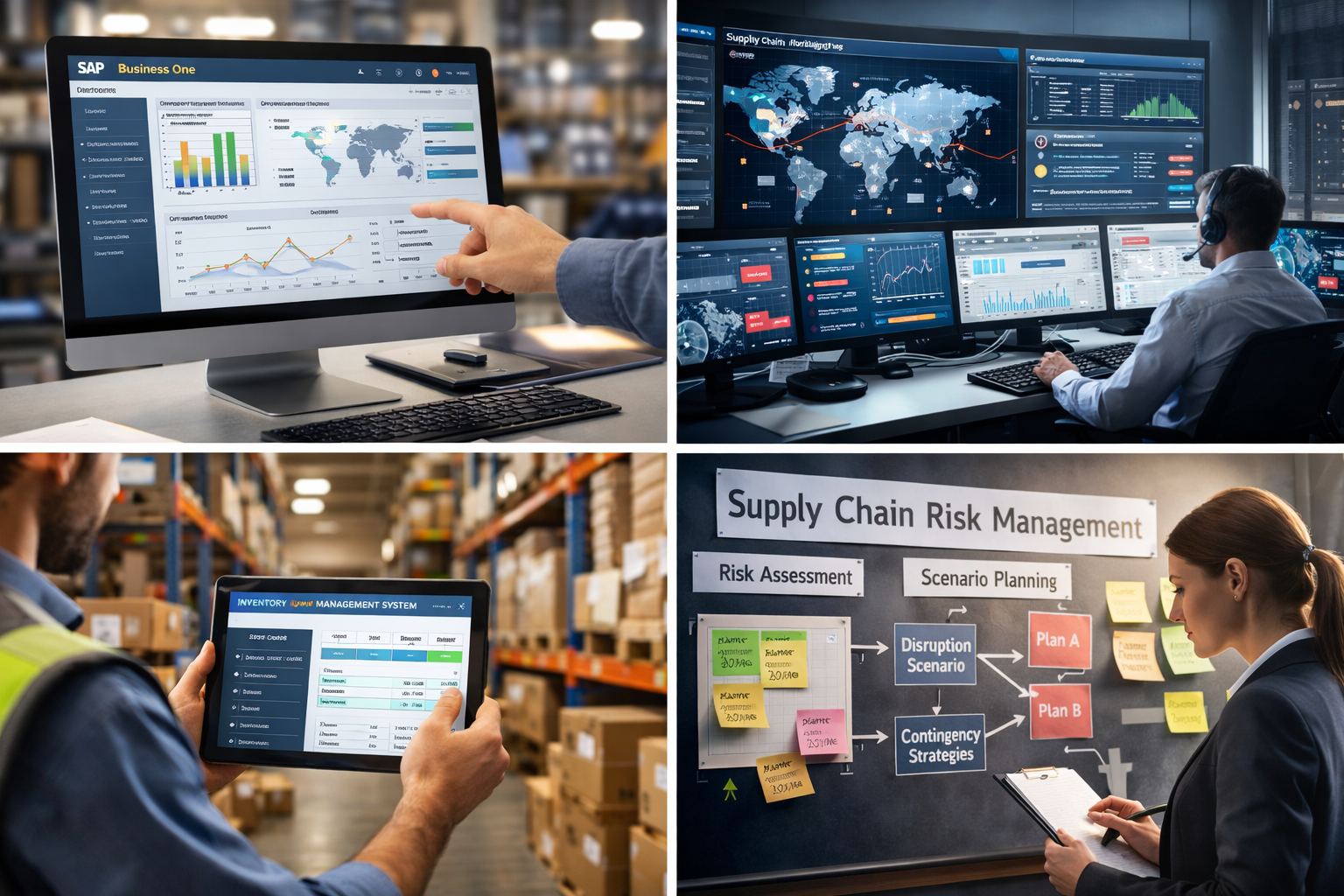
One of the greatest strengths of SAP Business One is its ability to provide real-time visibility across the entire supply chain. From procurement to production and distribution, decision-makers can monitor performance indicators instantly through interactive dashboards and KPIs.
Integrating Suppliers, Distributors, and Partners
SAP Business One enables seamless integration across stakeholders through cloud-based collaboration tools. This ensures that all parties—from suppliers to end customers—have access to synchronized data, reducing bottlenecks and miscommunications.
Predictive Analytics and Demand Forecasting
With built-in predictive analytics, companies can forecast demand patterns and adjust production accordingly. This minimizes waste, improves resource allocation, and enhances customer satisfaction through better delivery reliability.
Inventory Optimization and Warehouse Management
SAP Business One automates inventory replenishment, tracks multi-warehouse stock levels, and integrates with barcode and RFID systems to streamline logistics and minimize errors.
Building Supply Chain Resilience Using SAP Business One
Identifying and Mitigating Supply Chain Risks
The system provides visibility into potential bottlenecks, supplier dependencies, and production delays. Managers can proactively assess risks and implement contingency plans before disruptions occur.
Scenario Planning and What-If Analysis
SAP Business One’s simulation tools allow businesses to perform “what-if” analyses—testing different supply chain scenarios to identify optimal strategies for maintaining operations during crises.
Automating Workflows for Faster Decision-Making
Automation reduces manual processes, freeing teams to focus on strategic problem-solving. From purchase approvals to shipment tracking, automated alerts keep operations agile.
Ensuring Business Continuity During Disruptions
During global events such as pandemics or natural disasters, SAP Business One’s cloud deployment ensures that teams can operate remotely with uninterrupted access to real-time data.
Key Benefits of SAP Business One for Supply Chain Leaders
- Improved Efficiency: Streamlined operations reduce waste and errors.
- Cost Reduction: Automation minimizes overheads and optimizes resource use.
- Enhanced Transparency: Stakeholders gain full visibility into the supply chain.
- Increased Customer Satisfaction: Accurate delivery times and fewer stockouts improve trust.
- Regulatory Compliance: Centralized documentation ensures audit readiness.
Case Studies: Companies Achieving Supply Chain Resilience with SAP Business One
Manufacturing Industry Example
A mid-sized manufacturer implemented SAP Business One to gain real-time visibility into production and inventory. As a result, they reduced delivery delays by 35%, improved supplier collaboration, and achieved 20% faster order processing.
Distribution and Wholesale Example
A global distributor used SAP Business One to synchronize its regional warehouses. The company reduced inventory costs by 25% while maintaining optimal stock availability during global shipping disruptions.
Implementing SAP Business One: Best Practices
- Assess Current Supply Chain Maturity: Identify pain points before implementing.
- Customize Modules: Tailor SAP Business One functionalities to specific supply chain goals.
- Train Employees: Ensure user adoption through structured training.
- Monitor KPIs: Continuously track supply chain metrics for ongoing improvement.
Integration and Scalability of SAP Business One
SAP Business One integrates with:
- IoT devices for real-time asset tracking.
- AI platforms for predictive maintenance.
- Cloud ecosystems for data centralization.
Its scalability allows organizations to expand globally while maintaining consistent performance across regions.
Common Challenges in Using SAP Business One for Supply Chain Management
- Data Migration: Transitioning legacy systems can be complex.
- User Adoption: Resistance to new systems requires proper training.
- Cost & ROI: Upfront investment needs long-term ROI justification.
However, these challenges can be overcome through phased implementation and ongoing support.
Future Trends: SAP Business One and the Digital Supply Chain
AI-Powered Optimization
Artificial intelligence within SAP Business One will further enhance predictive analytics, enabling smarter demand forecasting.
Blockchain Integration
Blockchain technology ensures supply chain transparency, authenticity, and security—reducing fraud and counterfeiting.
Autonomous Supply Chains
Automation combined with AI will lead to self-optimizing supply chains capable of making independent, data-driven decisions.
FAQs About Using SAP Business One for Supply Chain Visibility and Resilience
1. Can SAP Business One handle global supply chains?
Yes, SAP Business One supports multi-currency, multi-language, and multi-location operations, making it ideal for global supply chains.
2. Is SAP Business One suitable for small businesses?
Absolutely. It’s designed specifically for SMEs that need enterprise-grade capabilities at an affordable cost.
3. How does SAP Business One improve demand forecasting?
It uses real-time data and predictive analytics to anticipate customer demand trends.
4. Can SAP Business One integrate with external logistics systems?
Yes. It supports integrations with logistics and warehouse management systems via APIs.
5. How long does implementation typically take?
Depending on complexity, it can range from 2 to 6 months for most SMEs.
6. What is the ROI of SAP Business One for supply chain optimization?
Companies typically report cost savings of 10–30% within the first year post-implementation.
Conclusion: Strengthening Supply Chains with SAP Business One
In an era defined by disruption, visibility and resilience aren’t optional—they’re mission-critical. Using SAP Business One for advanced supply chain visibility and resilience empowers organizations to stay proactive, data-driven, and competitive.
By uniting data, automation, and analytics under one platform, SAP Business One helps businesses not only survive disruptions but thrive through them—ensuring continuity, customer trust, and long-term growth.