

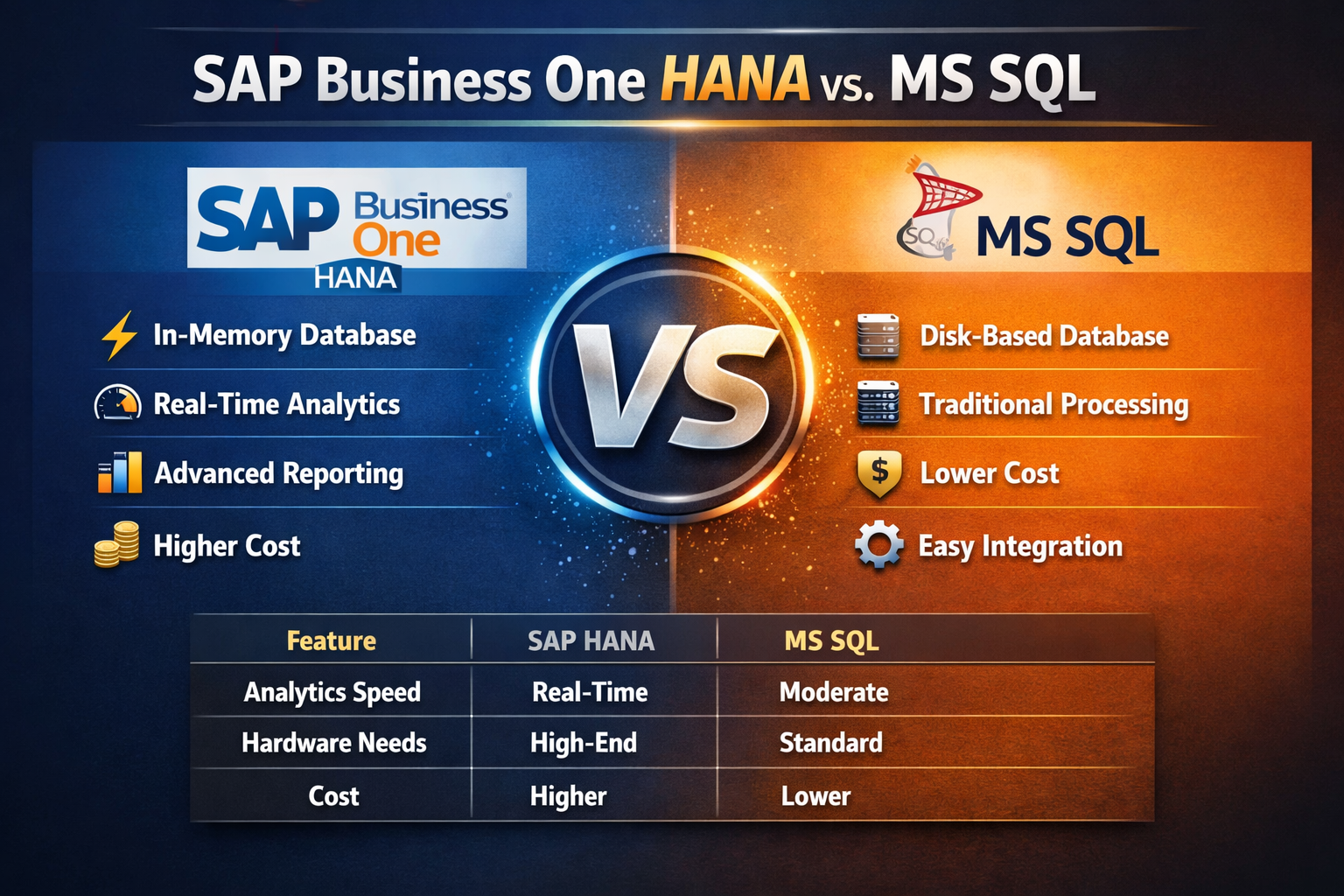
What Is SAP Business One
SAP SE developed SAP Business One as an enterprise resource planning (ERP) system designed specifically for small and mid-sized businesses. It helps manage:
- Finance and accounting
- Sales and customer management
- Purchasing and inventory
- Production and operations
- Reporting and analytics
What makes SAP Business One unique is that it can run on two different database platforms:
- SAP HANA
- Microsoft SQL Server
What Is SAP HANA?
SAP HANA is an in-memory database platform developed by SAP. Instead of storing data primarily on disk like traditional databases, HANA stores data in RAM.
This allows:
- Extremely fast data processing
- Real-time analytics
- Advanced predictive capabilities
- Integrated reporting tools
What Is Microsoft SQL Server?
Microsoft SQL Server is a traditional relational database management system (RDBMS). It stores data primarily on disk and retrieves it when needed.
It’s widely used across industries and integrates well with other Microsoft tools like:
- Excel
- Power BI
- Windows Server
- Azure
Core Differences Between SAP Business One HANA vs MS SQL
Let’s dive into the most important differences between SAP Business One HANA vs MS SQL that decision-makers should consider.
Database Technology: In-Memory vs Disk-Based
SAP HANA
- Stores data in memory (RAM)
- Column-based storage
- Designed for real-time processing
MS SQL
- Disk-based storage
- Row-based storage
- Optimized for transactional processing
👉 Result: HANA delivers faster analytics, especially for large datasets.
Performance and Speed
HANA excels in:
- Complex reports
- Real-time dashboards
- Large-volume analytics
- Multi-dimensional analysis
MS SQL performs very well for:
- Standard ERP transactions
- Financial processing
- Day-to-day operations
If your business needs instant reporting without waiting for batch jobs, HANA has the edge.
Reporting Capabilities
One of the biggest differences between SAP Business One HANA vs MS SQL is built-in analytics.
SAP HANA Includes:
- Real-time dashboards
- Pervasive analytics
- Interactive KPIs
- Advanced search functionality
MS SQL Includes:
- Crystal Reports
- External BI tools (like Power BI)
- Standard query-based reporting
HANA reduces dependency on external reporting tools.
Cost Structure
Let’s talk about money.
| Factor | SAP HANA | MS SQL |
|---|---|---|
| License Cost | Higher | Lower |
| Hardware | Requires certified high-memory servers | Standard servers |
| Implementation | More complex | Generally simpler |
| Maintenance | Specialized expertise | Widely available skills |
MS SQL is usually more budget-friendly upfront.
Hardware Requirements
HANA:
- Requires SAP-certified hardware
- High RAM requirements
- Specific infrastructure guidelines
MS SQL:
- More flexible hardware options
- Easier cloud hosting
- Less restrictive server requirements
This can significantly impact small business budgets.
Scalability
HANA scales very well for:
- Growing data volumes
- Real-time analytics expansion
- AI and predictive modeling
MS SQL also scales well but may require more tuning as data grows.
Advanced Analytics and AI
HANA supports:
- Predictive analytics
- Machine learning integration
- Text analysis
- Geospatial processing
MS SQL requires additional tools for similar functionality.
If innovation matters, HANA is more future-focused.
Data Compression
HANA uses columnar storage with high compression rates.
This reduces database size significantly.
MS SQL also offers compression but generally not at HANA’s level.
Custom Development and Add-ons
Many third-party SAP Business One add-ons support both platforms. However:
- Some advanced analytics add-ons are optimized for HANA.
- Custom SQL queries are easier to write for MS SQL if your team is already familiar with SQL Server.
Integration Capabilities
MS SQL integrates seamlessly with:
- Microsoft ecosystem
- Power BI
- Azure cloud services
HANA integrates well within SAP’s ecosystem and SAP-native tools.
Performance Comparison Table
| Feature | SAP HANA | MS SQL |
|---|---|---|
| Database Type | In-memory | Disk-based |
| Real-Time Analytics | Yes | Limited |
| Built-in Dashboards | Advanced | Basic |
| Predictive Analytics | Native | External Tools Needed |
| Hardware Flexibility | Limited | Flexible |
| Cost | Higher | Lower |
| Reporting Speed | Extremely Fast | Moderate |
Which Businesses Should Choose SAP HANA?
SAP HANA is ideal for:
- Fast-growing companies
- Businesses requiring real-time KPIs
- Companies focused on innovation
- Organizations with large data volumes
- Enterprises needing predictive analytics
Which Businesses Should Choose MS SQL?
MS SQL works well for:
- Small businesses with budget constraints
- Companies with stable data volumes
- Businesses already using Microsoft technologies
- Organizations prioritizing cost efficiency
Migration Considerations
If you’re currently on MS SQL and considering moving to HANA:
- Data migration planning is essential
- Hardware upgrades may be required
- Staff training will be necessary
- Implementation partners with HANA expertise are recommended
Always consult certified SAP partners before making a move.
For official documentation, you can review SAP’s database platform guidance here:
Frequently Asked Questions (FAQs)
1. Is SAP Business One HANA faster than MS SQL?
Yes. HANA processes data in memory, which allows significantly faster reporting and analytics.
2. Is MS SQL cheaper than HANA?
Generally, yes. MS SQL typically has lower licensing and hardware costs.
3. Can I switch from MS SQL to HANA later?
Yes, migration is possible, but it requires careful planning and certified SAP consultants.
4. Does HANA require special hardware?
Yes. SAP HANA requires SAP-certified servers with high memory specifications.
5. Which platform is better for reporting?
HANA offers more advanced real-time and interactive reporting capabilities.
6. Is MS SQL outdated?
No. MS SQL is still widely used and very reliable for standard ERP operations.
Final Thoughts: Making the Right Choice
Understanding the differences between SAP Business One HANA vs MS SQL helps you align your ERP strategy with your business goals.
If speed, analytics, and innovation are your top priorities — HANA shines.
If cost control, flexibility, and familiarity matter more — MS SQL remains a strong, reliable choice.
At the end of the day, the “best” option depends on:
- Your budget
- Your growth plans
- Your reporting needs
- Your technical infrastructure
Choose wisely — your ERP foundation will support your business for years to come.